Why Move-Day Readiness Matters More Than Packing
Most people think moving day problems happen because movers are slow or something goes wrong unexpectedly.
In reality, most delays and stress come from something simpler: the home wasn’t actually ready when loading began.
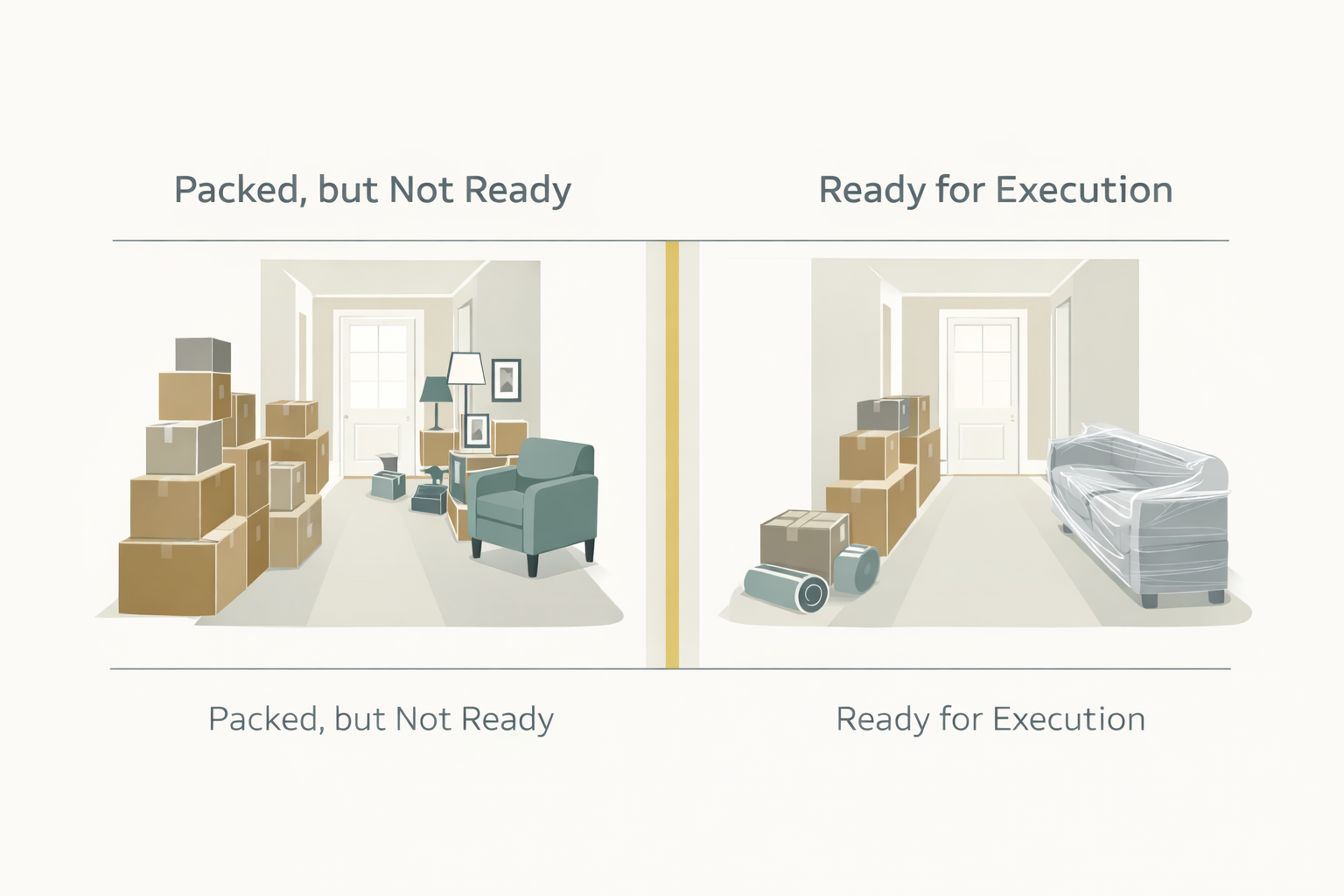
Packing might be mostly done. Boxes might be stacked. But readiness is about whether movers can arrive and immediately work in flow — without stopping to ask questions, re-handle items, or work around unfinished decisions.
This article explains why move-day readiness matters, what breaks when it’s missing, and how thinking about readiness early makes moving calmer and more predictable.
Why People Feel “Ready” When They’re Not
Most people judge readiness by effort.
They’ve packed boxes. They’ve cleared surfaces. The home looks orderly enough that it feels ready. But visual order and operational order are not the same thing.
Packing prepares items. Staging with real readiness prepares for an efficient move.
This is where most moves quietly go sideways.
A home can look calm and still slow a move down. Small decisions are unfinished. Items are packed but not staged. Furniture still needs to be wrapped or taken apart. These gaps don’t feel serious in advance, but they show up immediately once loading begins.
What Movers Actually Need on Arrival
When movers arrive, they’re not assessing how much effort you’ve put in. They’re assessing whether they can start working without friction.
That means clear walking paths that stay clear.
It means decisions are already made, not deferred until something is in the way.
It means items are staged to load efficiently, not stored the way they were used to live.
And it means preparation is finished before loading starts. Wrapping furniture, protecting artwork, or disassembling beds during the move pulls people away from loading and breaks momentum.
Readiness is about removing friction before movers step through the door.
What Happens When Readiness Is Missing
When readiness is incomplete, nothing dramatic usually happens. There isn’t a single obvious mistake.
Instead, time slips away.
Movers stop to ask questions. Items get handled twice. Small, handheld pieces pile up late in the load when space is limited and fragile items are already in the truck. Access points become tighter. Fatigue sets in earlier.
None of this looks like a problem in isolation. But together, it slows the entire day.
The result is often a longer move, more strain on the crew, and higher cost — even though everything technically got done.
This isn’t about blame. It’s simply how cause and effect works on moving day.

Readiness Is a Standard, Not a Feeling
Professionals don’t rely on how a move feels.
They work from standards.
Standards reduce decisions. They remove guesswork. They make it possible to execute instead of constantly adjusting.
That’s why readiness isn’t something you sense the night before. It’s something you confirm against a clear definition of what “ready” actually means.
This is also why it’s very difficult to be overprepared for a move, but surprisingly easy to be underprepared — even when you think you’re ready.
Different homes come with different challenges. Condos, townhomes, basement suites, and detached houses all have access constraints. The most reliable way to neutralize those complications isn’t luck or speed. It’s preparation that keeps the flow of the move intact.
This is why professionals think about readiness as a standard — not a checklist you glance at the night before.
What to Do If You’re Not Sure You’re Ready
If you’re unsure where you stand, start by stepping back.
If you want to understand the overall shape of your move — timing, access, and scope — begin with a high-level snapshot. It gives clarity without asking you to solve everything at once.
If you want to confirm that move day itself will run smoothly, the Move-Day Readiness Standard lays out what execution-level preparation actually looks like.
Both approaches reduce uncertainty. They simply operate at different levels.
Closing
You don’t need a perfect plan to have a good move.
You need clarity before movers arrive.
When move day becomes execution instead of problem-solving, everything feels easier.