Why Movers Lose Time on “Easy” Moves
Most people judge how hard a move will be by two things: how much stuff they have, and how far they’re going.
If it’s a small place, or the new home is only a few blocks away, the move often gets labeled as “easy.” Expectations are set early that it should be quick, straightforward, and low stress.
In practice, many of these “easy” moves are the ones that quietly run long.
Not because the items are heavy. Not because movers are slow. But because the conditions needed for smooth execution were never fully in place.
This article explains where time is actually lost on moves that seem simple, and what needs to be true for an easy move to stay easy.
If you haven’t already, it’s worth understanding why move-day readiness matters more than packing, since many of these issues happen even when everything appears boxed and ready.
What People Mean When They Say “Easy”
When customers describe a move as easy, they’re usually referring to perceived effort.
There isn’t much furniture. Items aren’t fragile. The distance is short. Maybe they’ve moved before and feel familiar with the process.
Those things do matter, but they aren’t what determines how efficiently a move runs.
From a mover’s perspective, difficulty isn’t about how hard items are to lift. It’s about whether work can stay in flow without interruption.
Moves become time-consuming when small frictions stack up, even if each one feels minor on its own.
Where Time Is Actually Lost on “Easy” Moves
On moves that are expected to be simple, time is rarely lost in one obvious place. It’s lost in pieces.
Here are some of the most common ones.
Access That Takes Longer Than Expected
Long walks, small elevators, tight staircases, or multiple turns between the unit and the truck don’t feel significant when you’re thinking about your belongings.
They matter a lot once the move starts.
A hallway or walk that exceeds 100 paces, especially when paired with stairs or elevator waits, adds time to every single trip. Walking both ways, loading and unloading dollies, and waiting for elevator cycles compounds quickly.
The items themselves may be easy to move. The path they travel is not.
Disassembly That Pulls a Mover Out of Flow
On smaller moves, crews are often limited to two movers.
When one person is tied up disassembling and later reassembling a bed, a desk, or a complex frame, the other mover is effectively working alone for 30 to 60 minutes.
During that time, items move more slowly, larger pieces require pauses, and stairs or long carries become far more taxing.
Nothing is “wrong” in this scenario. It simply isn’t efficient.
The Downsizing Trap
Downsizing moves are commonly assumed to be easier because there’s less coming out of the home.
Loading often is easier.
Unloading is where things slow down.
Smaller spaces require tighter placement decisions. There’s less margin for error, less room to temporarily stage items, and more uncertainty about where things actually belong.
Without clear plans for the new space, movers are forced to stop frequently to ask questions, shift items, or re-handle furniture that was already placed once.
Short Distance, Same Process
Moving three blocks instead of thirty minutes doesn’t change the work of loading or unloading.
The same number of items still need to come out of one space and go into another. The truck still needs to be packed and unpacked. Stairs, elevators, and access constraints still exist.
Distance affects driving time, not the complexity of the move itself.
The Early Signal Movers Notice
In many cases, movers can tell within the first 15 to 30 minutes whether a move will take longer than expected.
That signal usually isn’t the amount of stuff.
It’s the combination of access, preparation, and whether decisions are already settled.
If the walk is long, items are still being disassembled, or the home looks packed but not staged for movement, the pace will slow. Not dramatically at first, but steadily.
Customers often don’t feel this until later in the day, when time and cost have already crept upward.
What an Actually Easy Move Looks Like
When a move truly runs smoothly, it’s noticeable immediately.
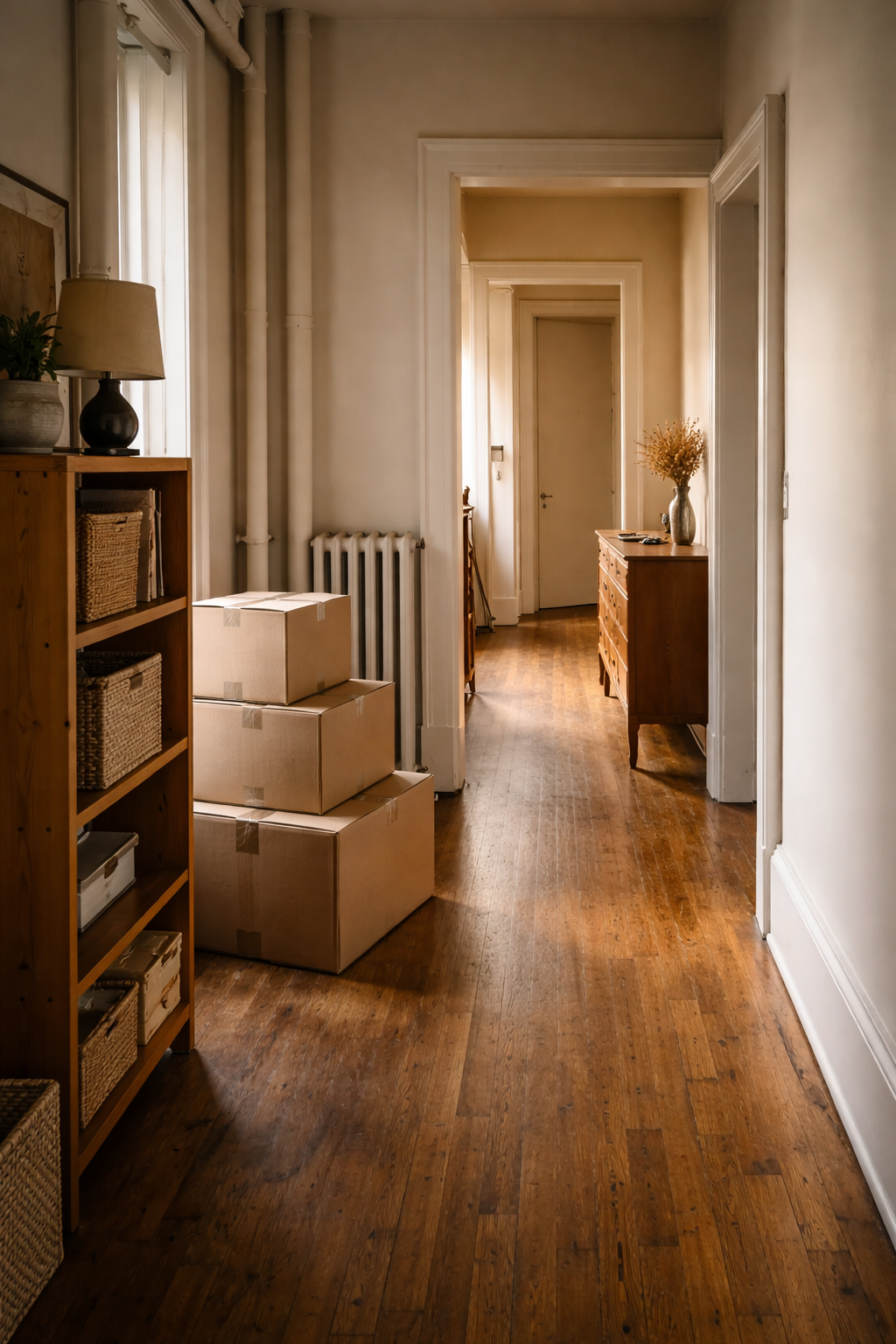
Boxes are neatly stacked and ready to move. Large items are already disassembled. Pathways are clear. The customer is calm and ready to start.
Awkward or high-interference items have either been handled in advance or clearly set aside. Furniture and boxes can be grouped, bundled, and moved efficiently using dollies instead of hand-carrying one or two items at a time.
In these cases, movers spend their energy moving, not stopping.
Access matters less because the workflow is protected.
How to Keep an “Easy” Move From Dragging On
This section focuses on the difference between a move that appears simple on the surface and one that is prepared for execution. The distinction is not about how much you own — it’s about whether conditions are in place to keep work moving without interruption.
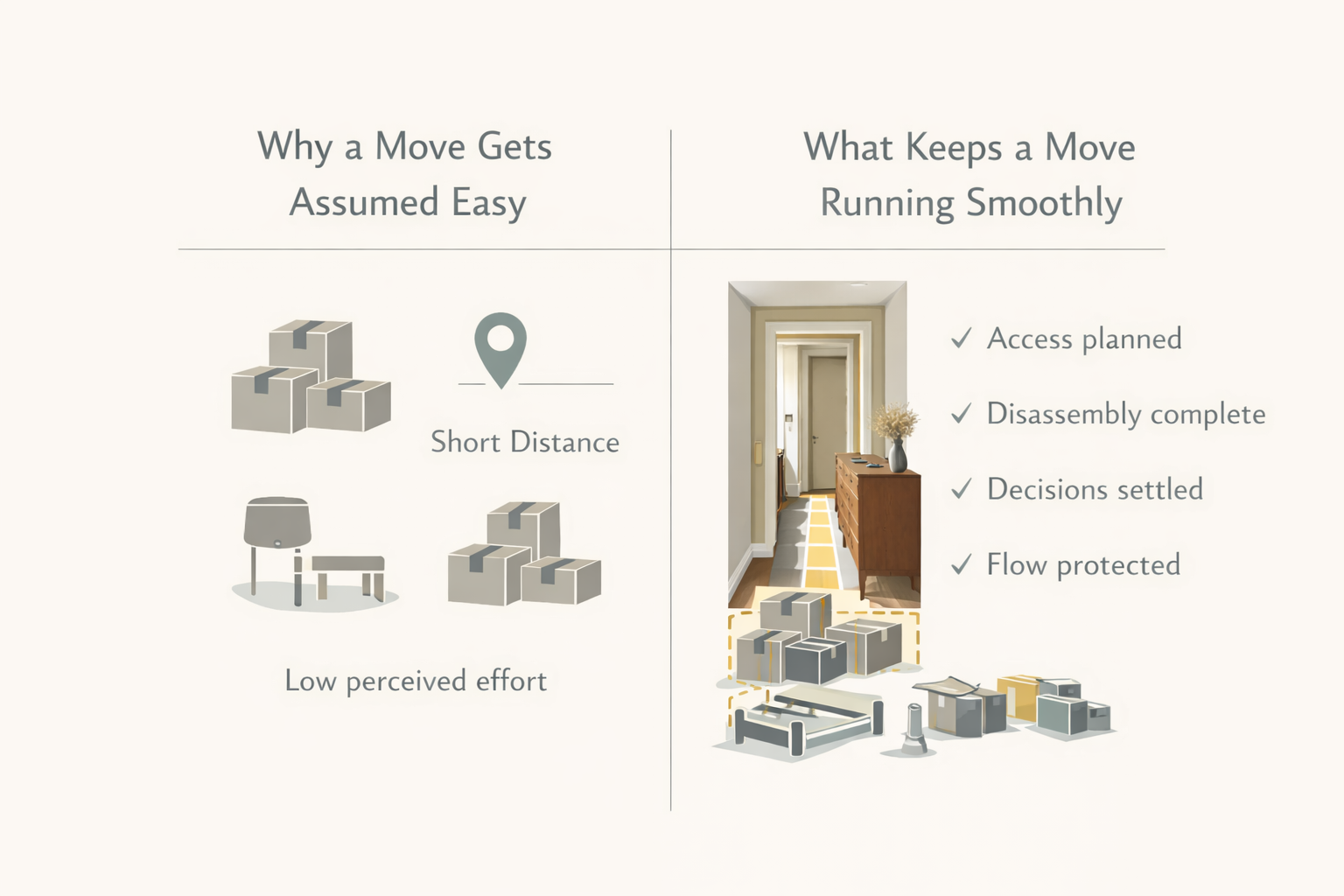
An easy move stays easy when certain conditions are already true before movers arrive.
These aren’t techniques or packing tricks. They’re readiness conditions.
Before move day, it helps to confirm that:
- Access is treated as a time factor, not a minor detail
- Disassembly is complete and not competing with loading
- Walk distances, elevators, and stairs are acknowledged and planned for
- Two-person crews aren’t forced into extended one-person work
- Loading and unloading are treated as equal parts of the move
When these conditions are in place, small moves stay efficient, short-distance moves stay predictable, and downsizing moves avoid unnecessary re-handling.
If you want a clear way to confirm these conditions before movers arrive, the Move-Day Readiness Standard lays them out in one place.
“Easy” stops being a guess and becomes a result.
The Bigger Pattern
Most moves don’t run long because of heavy items or bad luck.
They run long because the move looked finished on paper, but wasn’t ready for execution.
Packing is the starting point, not the finish line.
When preparation protects flow, movers can do what they’re there to do: move efficiently, safely, and without interruption.
That’s when an easy move actually feels easy.
If you want to see how this fits into the full moving process, you can explore the guides to understand what matters most at each stage of a move.