What Causes Delays on Moving Day (And How to Prevent Them)
Most moving day delays don’t come from bad luck.
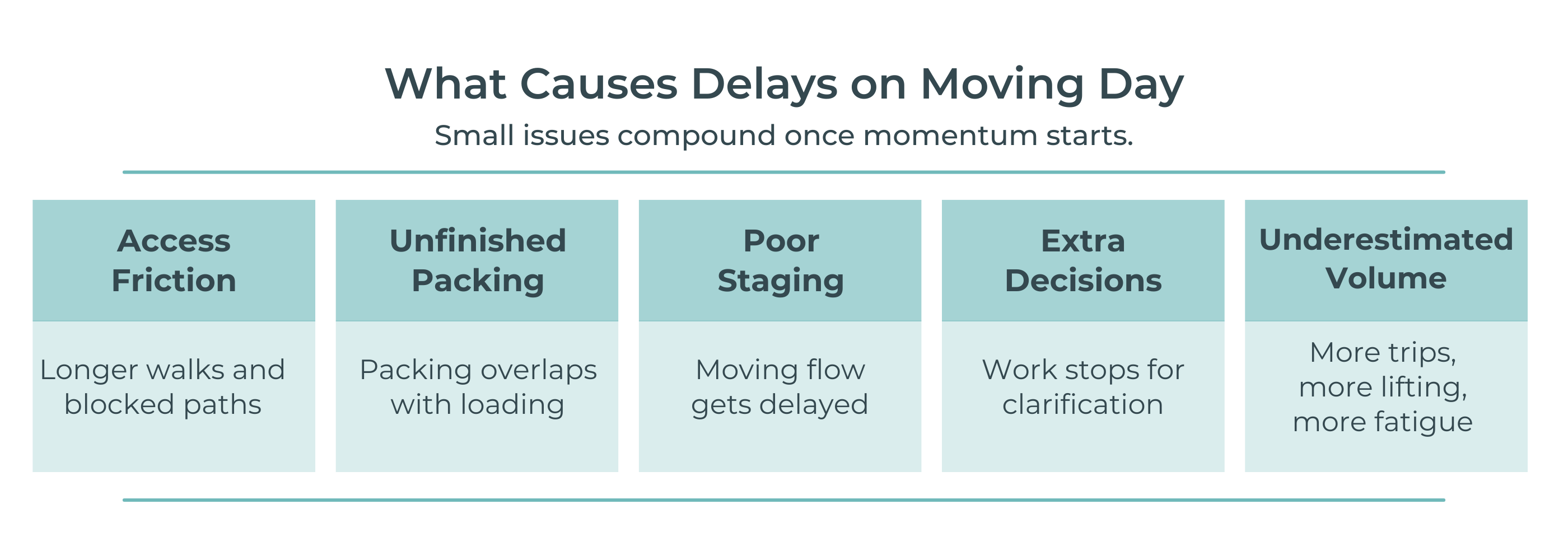
They come from small planning gaps that only become visible once the move is already in motion. By the time loading starts, flexibility disappears. Every delay compounds because decisions now have time, cost, and energy attached to them.
This article explains the most common causes of moving day delays, why they happen, and how to prevent them before they affect the schedule.
Why delays feel worse on moving day
Moving day runs on momentum.
Once the truck arrives, the day is no longer theoretical. The clock is running, energy is finite, and changes are harder to absorb. Even minor slowdowns feel heavier because they interrupt flow rather than simply shifting a plan.
If you’re not familiar with how the day typically unfolds, it helps to understand what actually happens on moving day before trying to diagnose delays.
Delays are rarely caused by one big mistake. They’re usually several small oversights stacking together.
Access issues that weren’t fully confirmed
Access is tested on moving day, not during planning.
In apartments and condos, delays often come from elevators, loading areas, entry rules, or long walks from the truck to the door. In houses, it’s more often tight driveways, steep stairs, narrow turns, or long carries from street parking.
Even when access is discussed ahead of time, assumptions tend to remain. On moving day, that turns into slower trips and more handling. Time disappears quickly when every trip takes longer than expected.
Prevention:
Confirm access in practical terms. If it’s a building, verify rules and bookings where required. If it’s a house, do a realistic walk from where the truck will park to the main entrance and assume it will take longer once items are in hand.
Packing that isn’t actually finished
Unfinished packing is one of the most common causes of delays.
Boxes may be mostly packed but not sealed. Closets might be untouched. What feels like a few remaining items often turns into entire rooms once moving starts.
The real issue is overlap. Packing and loading happen at the same time, breaking flow. Work pauses, items pile up, and decisions get forced under pressure.
This is exactly why a timeline-based moving checklist matters. Packing needs a clear end point before moving day begins.
Prevention:
Treat packing as a separate phase that ends before moving day begins. If certain items must stay out, isolate them clearly so they don’t interrupt loading.
Staging that creates friction
Staging determines speed.
When boxes are spread across rooms, furniture blocks pathways, or items for different destinations are mixed together, movement slows and questions increase. Even brief pauses add up across hundreds of trips.
This applies to DIY moves and professional moves alike. With movers, pauses often translate into higher cost. With DIY, they translate into fatigue and a longer day.
Prevention:
Stage items to reduce decision-making. Keep walkways clear, group boxes by destination, and make “not going” items obvious so nothing needs to be re-sorted mid-move.
Too many decisions left for the day itself
Moving day is a poor time for decisions.
If it’s unclear what stays with you, what needs special handling, or where items should go, work stops while you decide. Those interruptions are often short, but they happen repeatedly.
Prevention:
Make decisions earlier, even if they’re imperfect. Clear direction beats last-minute optimization.
Underestimating volume and trips
Underestimating volume doesn’t just affect truck size. It affects time.
More items mean more trips, more handling, and more fatigue. When the workload exceeds expectations, the pace drops naturally even if everyone is working hard.
This shows up most often with basements, storage areas, garages, and secondary rooms that weren’t fully accounted for. It’s the same issue explored in more detail in underestimating volume.
Prevention:
Assume volume is higher than you think and reduce before you pack. Every item removed is time saved later.
Weather as a secondary amplifier
Weather rarely causes delays on its own.
Rain, snow, or extreme heat slows movement and increases fatigue. If the move is already tight, weather magnifies inefficiencies that were already present.
Prevention:
Plan for slightly slower movement when conditions aren’t ideal and prioritize safety over speed.
When small issues stack together
Most delayed moves don’t fail at one point. They slow gradually.
A longer walk to the truck. A few unfinished boxes. Extra questions. Slightly higher volume. None of these alone stops a move. Together, they change the entire pace of the day.
That’s why delays feel frustrating. Everyone is busy, yet progress feels slower than it should.
What to do first if you’re not sure
If you want to reduce the risk of delays, start with the biggest friction points.
Confirm realistic access. Finish packing before the day begins. Stage for flow. Reduce the number of decisions you’ll need to make once loading starts.
A simple structure makes these steps easier to see and follow.
→ View the free 1-Page Move Snapshot
Closing perspective
Delays are normal. What matters is how much they compound.
Preparation doesn’t eliminate every slowdown, but it keeps small issues from becoming large ones. When decisions are made earlier and the flow is clear, the day stays manageable even when things aren’t perfect.
→ Explore the Moving Mentor System