Moving Day: What Actually Happens and How to Prepare
Moving day often feels stressful not because the work is difficult, but because the day unfolds faster than expected. Decisions stack up. Time feels compressed. Small delays ripple into larger problems.
Most people imagine moving day as a single event. In reality, it follows a familiar sequence of stages. Understanding those stages ahead of time helps you prepare in the right order and avoid solving problems when there’s no room for error.
Why moving day feels chaotic
Most moving-day stress comes from compression. Tasks that could have been handled calmly over weeks collapse into a few hours.
When access isn’t ready, items aren’t staged, or decisions haven’t been made in advance, you’re forced to make choices in real time. Nothing is necessarily going wrong, but pressure rises quickly.
The goal isn’t to eliminate friction entirely. It’s to remove decisions from the day itself.
The real stages of moving day
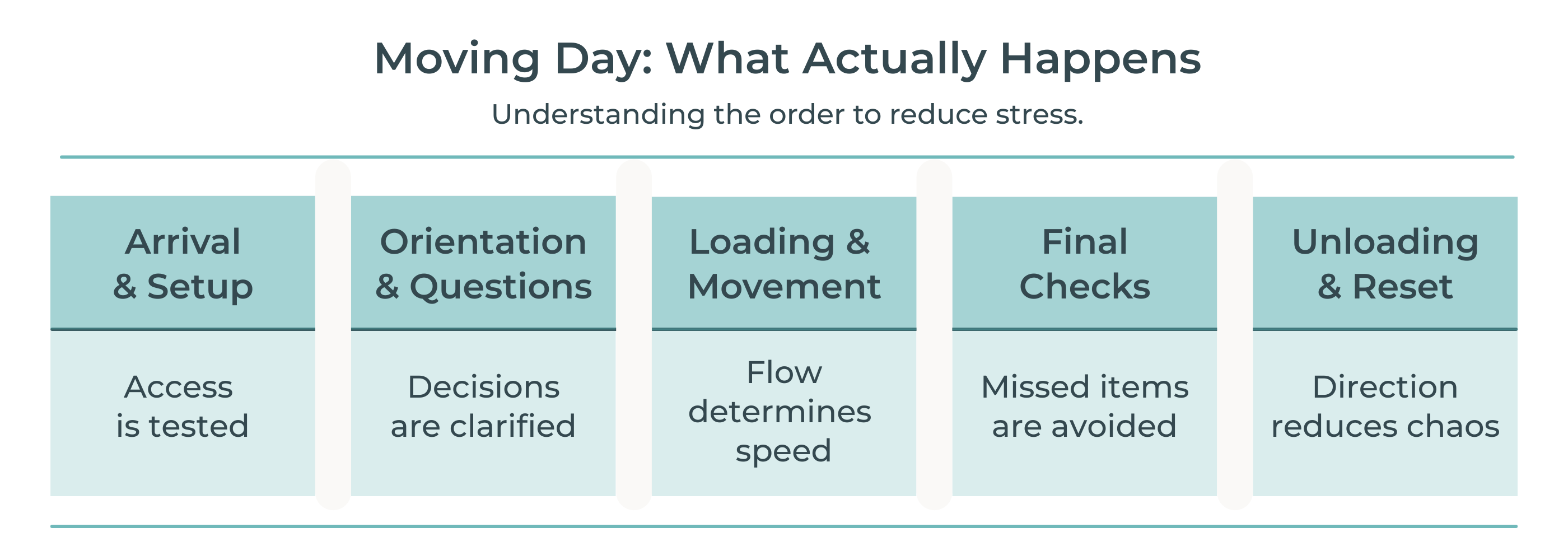
Most moves follow the same five stages, whether you’re prepared or not. Problems usually appear when one stage isn’t ready before the next begins.
Stage 1: Arrival and setup
The day starts with access. Vehicles arrive. Doors open. Pathways are tested.
This is where friction shows up first. Tight stairs, longer walks, blocked elevators, or unclear parking plans slow momentum immediately. If the home isn’t ready when the move begins, delays compound early.
Preparation here matters more than speed.
Stage 2: Orientation and questions
Before items start moving, there’s a short orientation phase.
If you’re working with movers, this is when they’ll ask about fragile items, items staying behind, access rules, and anything that needs special handling. If you’re doing the move yourself, this is when you mentally confirm loading order and flow.
Questions left unanswered at this stage usually resurface later, when time is tighter and changes are harder to make.
Stage 3: Loading and movement
This is the longest and most demanding phase of the day.
Flow matters more than effort. Clear paths, grouped items, and staged boxes allow continuous movement. Interruptions slow everything down. Searching for boxes, repacking items, or clearing obstacles mid-load adds time quickly.
Fatigue also builds here. Once energy drops, efficiency follows.
Stage 4: Final checks and departure
As loading wraps up, attention often drops. This is when items are most commonly left behind.
Closets, drawers, balconies, storage areas, and refrigerators are frequent misses. A slow final walkthrough prevents frustration later, especially if returning isn’t simple.
Stage 5: Unloading and reset
Unloading feels easier, but decision fatigue is highest at this point.
When rooms aren’t clearly identified, items land wherever space is available. That makes the next few days harder than necessary. Even basic direction reduces chaos during this phase.
What changes when professional movers are involved
The stages themselves do not change, but the margin for error does.
With movers, arrival windows are fixed, and delays translate directly into time and cost. Access issues, unclear instructions, or missing decisions are felt immediately.
This is why planning for a mover-led day often improves DIY moves as well. The structure forces clarity early, when changes are easier to The structure forces clarity.
What usually goes wrong on moving day
Most moving-day problems trace back to decisions left too late.
Unclear “do not move” items, blocked access routes, missing supplies, or unresolved parking details don’t feel serious weeks earlier. On moving day, they interrupt flow and force immediate fixes.
Moving day works best when it’s execution, not decision-making.
What to do first if you’re not sure
If you want to reduce stress quickly, focus on removing the biggest unknowns before the day arrives.
Confirm access. Decide what is and isn’t moving. Stage items so movement is straightforward. Once those are clear, everything else becomes easier.
→ View the free 1-Page Move Snapshot
Closing thought
Moving day doesn’t need to feel chaotic. It feels that way when too many decisions are forced into a short window.
When the order is clear and preparation happens earlier, the day becomes predictable. Work replaces worry.
→ Explore the Moving Mentor System
It’s designed to turn moving day from a scramble into a controlled, manageable process.