Why Moving Is More Stressful Than People Expect
Moving stress isn’t just “a lot to do.” It’s the mental load of managing uncertainty while your home is in transition.
Even an organized move can feel heavy because you’re juggling decisions, deadlines, access constraints, and the fear that something will go wrong. A single surprise — tight stairs, bad parking, missing supplies, a delay — forces you to re‑plan in real time.
This article explains why that happens, what patterns make it worse, and how to reduce stress by improving structure, communication, and preparation.
Why this feels hard
Most moving stress comes from interruption.
You start with a plan, but the plan keeps getting rewritten. Elevators are slower than expected. Parking changes. A large item doesn’t fit the turn. Supplies run low.
At the same time, you’re operating with incomplete information. You don’t know how long access will take, whether fragile items will be handled properly, or what the final timeline will look like.
When people are paying hourly, uncertainty feels expensive. Every delay feels like time slipping away. This is why predictability matters more than speed.
The most common mistake
Most people try to reduce moving stress by working harder.
They pack longer hours, add more tasks, and try to control everything — but they don’t reduce the unknowns.
If the unknowns stay in place, stress stays in place.
A calmer approach treats moving stress like risk management. You reduce it by shrinking the number of surprises and making the remaining ones easier to handle.
How stress builds during a move
Planning creates the mental load
Planning starts as a short checklist. It quickly expands into dozens of small decisions.
What gets packed early. What stays accessible. What needs special handling. What can’t be boxed yet.
If those decisions aren’t made early, they don’t disappear. They resurface later under pressure.
Takeaway: Decisions delayed become decisions made while stressed.
Friction appears when the plan meets reality
Friction is anything that slows the work down:
- Long carries, stairs, or tight turns
- Shared or delayed elevators
- Parking restrictions or long walks
- Extra handling for fragile or high‑value items
These factors are common and often predictable, but only if they’re planned for.
This is also where estimates feel confusing. Quotes are usually based on assumptions. When access or preparation is harder than expected, time changes.
Takeaway: Most “surprise costs” come from real friction, not hidden fees.
Interruption is where stress spikes
Interruption happens when friction forces a decision immediately.
A truck can’t park. An item won’t fit. The team needs more wrap. The plan has to change.
Nothing is necessarily going wrong — but your sense of control drops.
Takeaway: Stress spikes when decisions are forced in real time.
Monitoring becomes exhausting
Once interruptions begin, people start monitoring everything:
- Watching the clock
- Worrying about damage
- Tracking fragile items
- Trying to predict the final cost
This is mental work, and it’s tiring. Sentimental or high‑value items raise the perceived risk even further.
Takeaway: Monitoring is invisible effort, but it drains energy fast.
Fatigue makes problems feel bigger
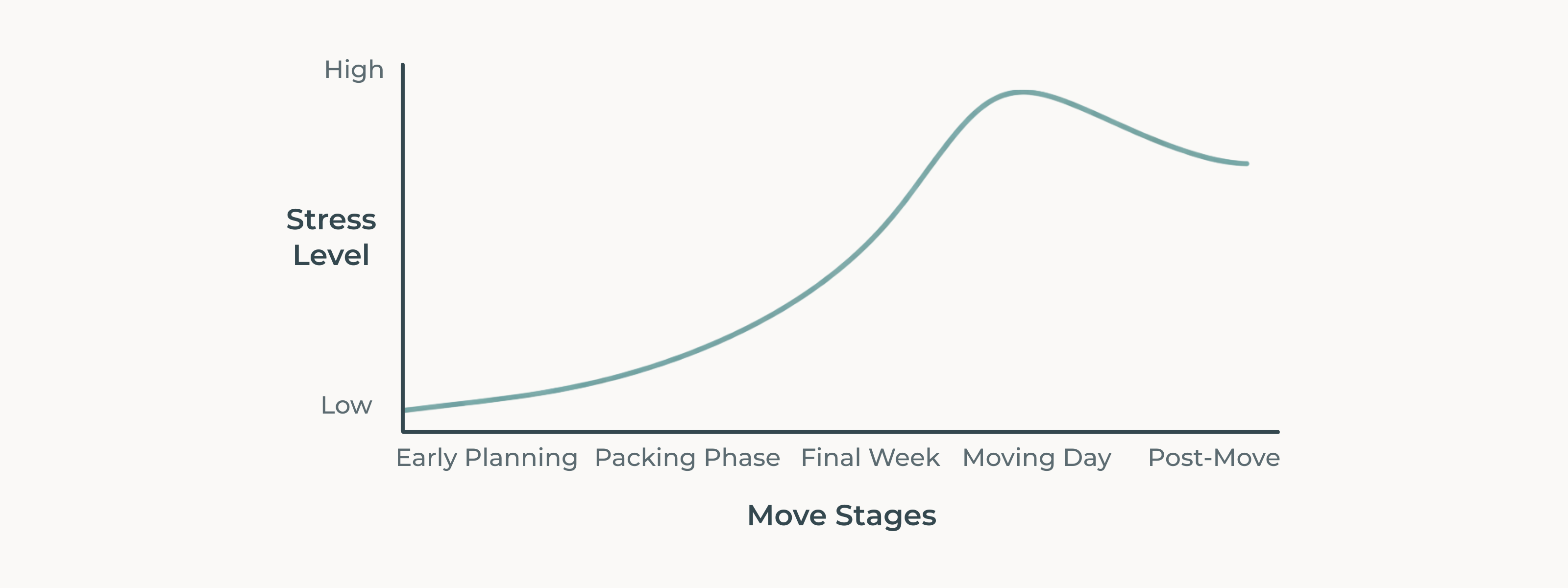
Stress often peaks on move day or just after it.
That’s when uncertainty and fatigue overlap. Decision‑making slows. Small problems feel larger. Communication gets shorter.
Once the home is stable again, stress declines — even if there’s still work to do.
Takeaway: Stress peaks when uncertainty and fatigue overlap.
When stress usually rises
A common pattern looks like this:
- Early planning: Low stress, many decisions ahead
- Packing phase: Gradually rising stress
- Final week: Steeper rise as deadlines approach
- Move day: Peak stress
- Post‑move: Slow decline as uncertainty fades
Good preparation doesn’t eliminate stress, but it makes the peak far more manageable.
What to do first if you’re unsure
If you want to feel calmer quickly, reduce the biggest unknowns first:
- Confirm parking and building access
- Confirm elevator booking rules
- Create a simple staging zone
- Identify items needing special wrapping
Then use a simple structure to organize everything else.
→ View the free 1‑Page Move Snapshot
Closing insight
Moving feels stressful because your home becomes a live project with real‑time consequences.
The goal isn’t to eliminate every friction point. It’s to make the move predictable enough that your brain can relax.