How to Protect Fragile Items Without Overpacking Everything
Fragile items don’t break because they’re fragile.
They break because they’re allowed to move inside the box.
Most people assume protection comes from more material — more paper, more bubble wrap, more padding everywhere. That feels logical. It also leads to heavier boxes, wasted time, and no real improvement in outcomes.
In practice, protection comes from context: how an item is oriented, what surrounds it, and whether it can shift once the box is closed.
Overpacking often creates the illusion of safety while quietly introducing new risks.
Why overpacking feels safe — and why it often isn’t
Overpacking usually happens when people think in terms of individual items instead of box behavior.
A glass wrapped aggressively feels protected in your hands. But once that glass goes into a box that’s soft, uneven, or overfilled with compressible material, the protection becomes unreliable. Under weight, padding compresses, gaps form, and items begin to shift.
What actually matters isn’t how much wrapping you used. It’s whether the contents are locked in place once the box is closed.
If a box can flex, settle, or crush, fragile items are at risk no matter how padded they look. This is why packing for movement matters more than packing for appearance.
Glass survives best when it’s supported, not suspended
Glass breaks when force is concentrated at a weak point.
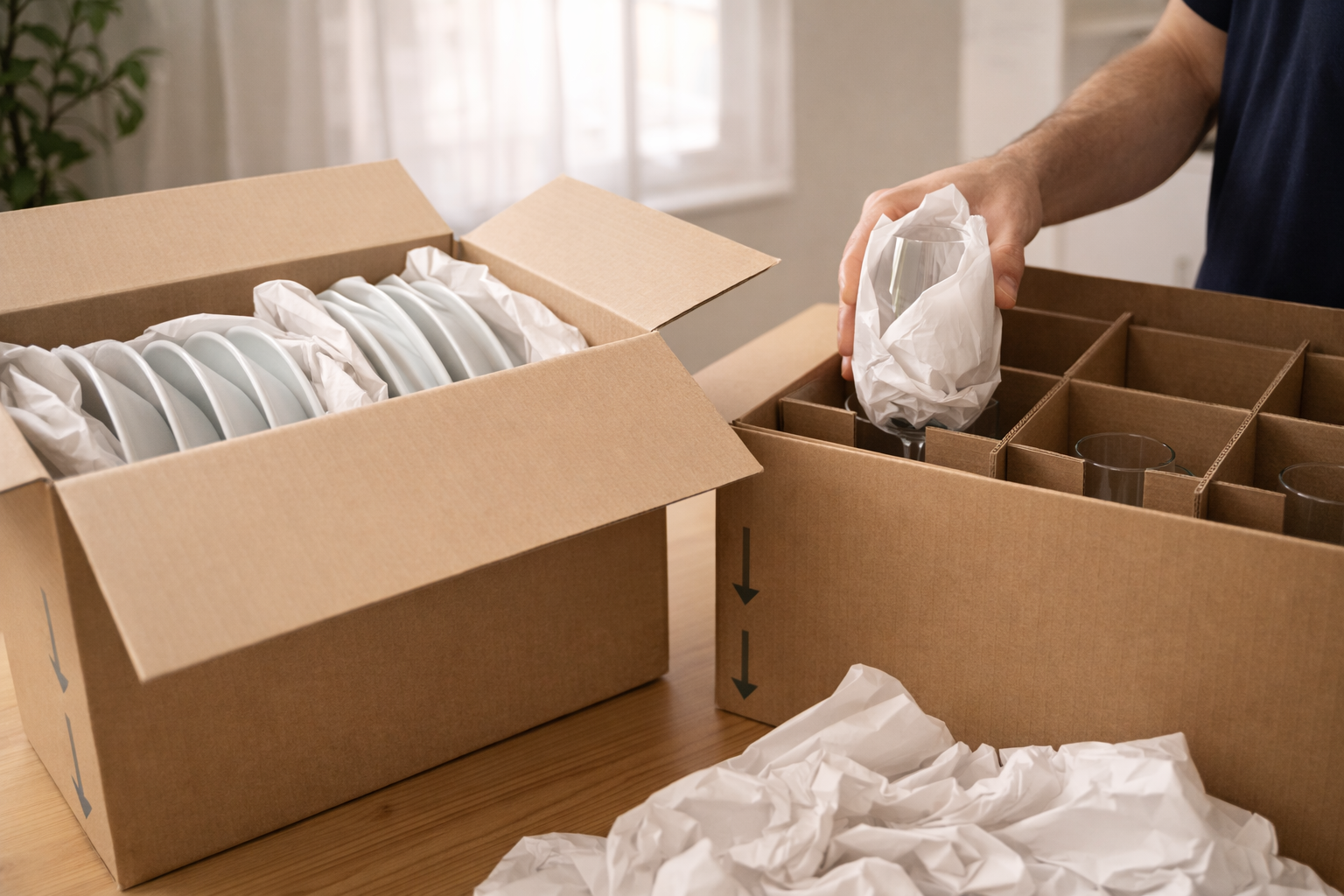
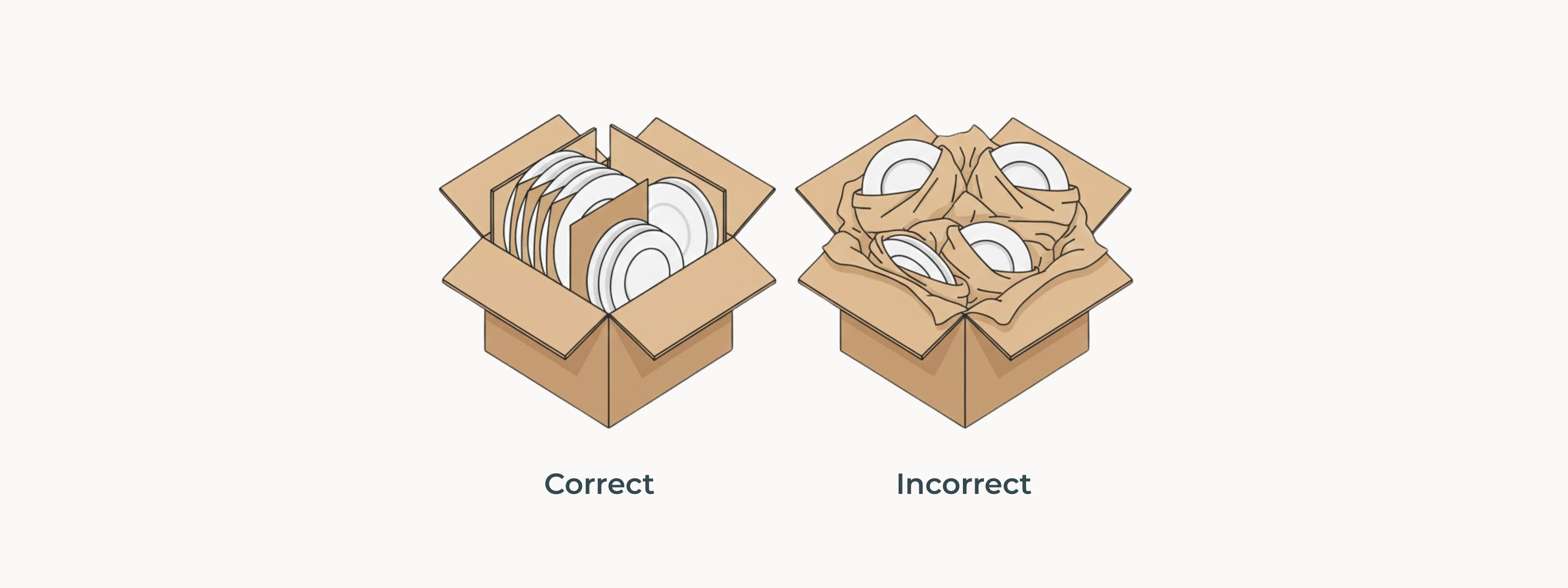
The safest setup isn’t glass floating in layers of paper. It’s glass that’s packed upright, evenly supported on all sides, with no empty pockets that allow movement.
While many people instinctively pack dishes flat, professional movers almost always pack them on edge. Upright packing distributes pressure more evenly and reduces the chance of a single plate absorbing weight from above.
Paper works best when it’s used to separate and stabilize, not to create soft voids. When packed correctly, the box becomes a solid unit — not a cushion.
A simple test movers trust: gently shake the box. If nothing shifts, the protection is doing its job.
Soft items can help — but they’re a tradeoff
Clothing, towels, and linens can protect fragile items, but they come with consequences.
Soft items are effective at filling irregular gaps and preventing movement. In tight-budget situations, they’re a viable alternative to packing paper if used deliberately and packed tightly.
That said, packing paper is still the better option whenever possible.
Paper is faster to work with, easier to control, and far cleaner during unpacking. Clothing-based packing almost always slows both packing and unpacking, and makes it harder to identify fragile boxes once they’re opened.
Soft items should be treated as a budget-friendly substitute, not the default.
When extra protection isn’t needed
Not every fragile item requires heavy wrapping.
Plates, mugs, and everyday decor often travel safely with modest protection when packed upright in small, well-filled boxes. Once movement is controlled and pressure is evenly distributed, additional layers don’t meaningfully reduce risk.
In fact, excessive wrapping can make boxes heavier, harder to stack, and more prone to crushing under load.
Professional movers rely far more on tight packing and consistent box weight than on excessive material.
The real risk isn’t fragility — it’s box behavior
Breakage rarely happens because an item was delicate. It happens because the box itself failed.
Boxes fail when items can shift, weight isn’t distributed evenly, or the box compresses under load. Those are system problems, not wrapping problems.
A well-packed box behaves like a solid object. A poorly packed one behaves like a bag of loose parts.
No amount of extra padding can fix that.
The takeaway
Protecting fragile items isn’t about wrapping harder. It’s about packing smarter.
When items are oriented correctly, supported evenly, and locked into place, they move safely with far less material than most people expect.
Overpacking doesn’t reduce risk. Understanding context does.