
What Makes a “Simple” Move Turn Complicated
Complexity doesn’t come from square footage. It comes from access, friction, and flow.
Some moves look simple on paper right up until move day. Not because anyone was careless, but because the factors that slow a move down aren’t always obvious during planning.
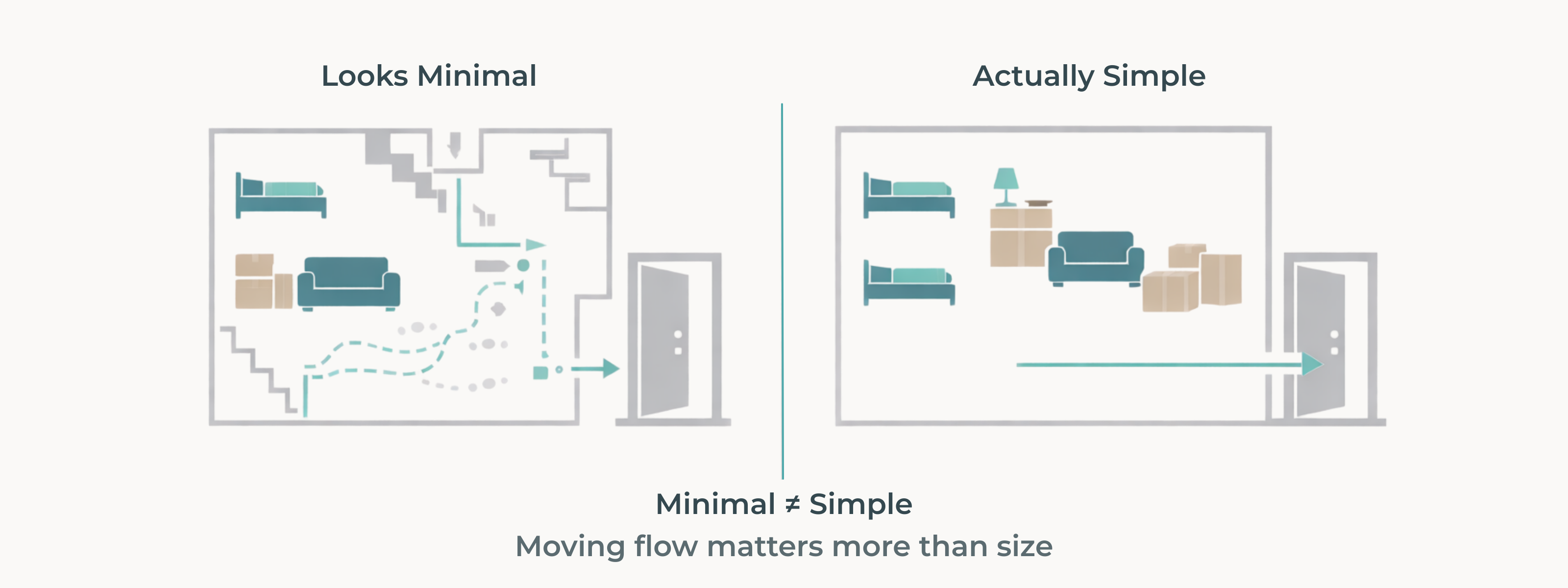
A small home with difficult access will often take longer than a larger home with clean flow. The difference is rarely how much stuff there is. It’s how smoothly that stuff can move.
Square footage is a misleading metric
Square footage tells you how much space a home takes up. It doesn’t tell you how efficiently items can travel from the unit to the truck.
A studio can be more complex than a three-bedroom house if it involves tight corners, interior stairs, long carries, or awkward access. What matters most is the path your items must take and how many times that path is repeated.
Stairs change the entire move
Stairs don’t just add effort. They change how movers have to work.
Interior and narrow staircases are especially challenging because large items can’t move in a straight line. They have to be angled, rotated, and eased around corners. Walls, railings, and ceilings limit movement, and a single tight turn can stop momentum completely.
Even a short run of stairs often means slower pacing, more careful handling, and more communication between movers, regardless of how small the move seems. This is one of the reasons access planning matters more than home size.
Long walks compound faster than people expect
A long walk doesn’t feel dramatic once. The problem is repetition.
On a move, that same distance is walked dozens of times while carrying weight, pushing dollies, handling two-person items, and working through fatigue.
Complexity rises quickly when routes are uneven, hilly, bumpy, or indirect. Many condo and apartment moves become quietly complex because trucks can’t park close, forcing long or indirect carry paths.
Bags feel efficient, but usually aren’t
Bags are one of the most common hidden slowdowns in moves that appear simple.
They feel convenient, but they rarely move efficiently. Bags don’t stack cleanly, don’t ride well on dollies, shift during transport, and often require extra handling in the truck.
Boxes move faster than bags.
The main exceptions are real luggage filled with light, soft items. Even then, bags work best as essentials storage rather than the primary packing system. This is where packing for movement makes a measurable difference.
Disassembly quietly pulls the team apart
Disassembly doesn’t just take time. It changes how the crew functions.
On most moves, the most experienced mover handles disassembly and reassembly. That person is often also the fastest mover.
When they’re tied up on a bed frame or sectional, one mover is removed from loading or unloading, and the remaining mover is usually slower. This is why small moves can drag when disassembly isn’t expected or planned for.
The takeaway
A truly simple move isn’t defined by size. It’s defined by how cleanly items can move from start to finish.
When access is clear, paths are direct, items stack well, and disassembly is expected, even larger moves can feel smooth.
When those things aren’t in place, even the smallest move can become complex.