
What Actually Makes a Move Expensive (And What Doesn’t)
Most people assume moving costs are driven by distance. How far the truck goes. How many kilometers show up on the invoice.
That’s rarely the real story.
Moving gets expensive when friction shows up on moving day — delays, obstacles, and last-minute problem-solving that slow everything down. Distance matters, but it’s usually secondary.
This article breaks down what actually drives moving costs, what surprisingly doesn’t, and where most moves quietly get more expensive than they need to be.
Why this feels hard to predict
Moving quotes feel unpredictable because the biggest cost drivers don’t reveal themselves until the truck arrives.
Two moves can look identical on paper:
- Same home size
- Similar number of boxes
- Similar distance
One finishes smoothly. The other runs hours over.
The difference is almost always access, preparation, and flow — not effort. This is why moving costs often feel disconnected from distance alone.
The most common mistake
The most common assumption is this:
“If we pack well and the move isn’t far, the cost should be reasonable.”
Packing helps. Distance matters. But neither protects you from friction.
Moving day pricing is driven by how efficiently movers can work once they arrive, not how hard they work or how far they drive. This is why moving day planning affects cost more than most people expect.
What actually makes a move expensive
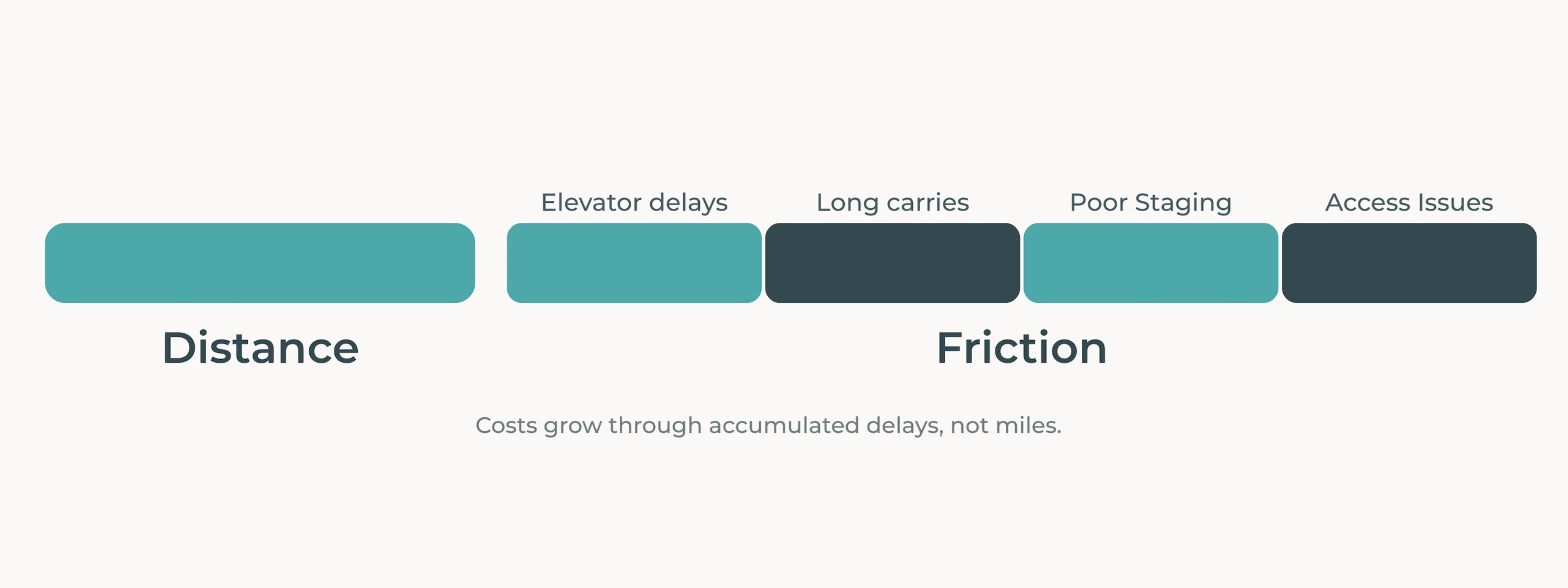
Long carries
Long carries are one of the most misunderstood cost drivers.
They’re not just about where the truck parks.
You can park right at the lobby and still have a long carry if the unit is far from the elevator, corridors are long or winding, or the unit sits at the far end of the floor.
Every extra step gets repeated hundreds of times.
Why it matters: A delay of a few seconds per item compounds across an entire home.
Takeaway: Long carries are about unit door to unit door, not curb to lobby.
Elevator delays
Elevator issues don’t just slow moves. They break momentum.
The biggest challenge is shared elevators.
When movers have to share with residents, elevators get called away mid-cycle, loads can’t be filled efficiently, and stops at other floors add up quickly.
Other common issues include access delays, restricted service elevators, or protection not installed on time.
Why it matters: Movers waiting still count as time on the clock.
Takeaway: If you’re in a building, elevator planning matters as much as packing.
Poor staging before movers arrive
This is where most moves quietly go sideways.
Common staging problems include boxes spread across rooms, loose items in piles, furniture still assembled or blocked in, and bags instead of boxes.
Movers end up sorting instead of moving.
Best-practice staging keeps boxes near the exit, consolidates loose items, and ensures most items are stackable or dolliable. This is where a clear moving day plan makes a measurable difference.
Why it matters: If it can’t go on a dolly, it slows the move.
Takeaway: Moving day should be execution, not sorting.
Access issues that could’ve been avoided
These issues don’t sound expensive until they stack up.
Examples include missing parking permits, blocked driveways, tight stairwells not measured in advance, or downtown parking not planned ahead.
Each one adds delay. Together, they compound.
Takeaway: Most access problems aren’t surprises. They’re missed planning steps.
What surprisingly doesn’t drive costs as much
Distance (within reason)
On most local moves, distance doesn’t scale costs as much as people expect.
Once the truck is loaded, an extra 10–20 minutes of driving often matters less than repeated delays at the building.
That said, context matters. In dense cities, a few kilometers can easily turn into significant time lost to traffic or parking.
Takeaway: Distance matters, but friction usually matters more.
How careful movers are
Careful movers aren’t slower movers.
Professional crews are trained to move efficiently and safely at the same time. Damage usually comes from rushed decisions and poor flow, not steady work.
Takeaway: Smooth systems protect both your belongings and your timeline.
Hourly vs flat-rate pricing
Hourly pricing is where friction shows up most clearly. Delays increase time, and time affects cost.
Flat-rate pricing shifts that risk. You get price certainty, but movers price in unknowns up front.
Flat rates don’t remove friction. They just change where the cost appears.
What to do first if you’re not sure
If you want to control costs, start by confirming parking and building access, booking elevators early, and staging everything being moved near the exit.
If you want a quick way to see where friction might show up in your move:
→ View the free 1-Page Move Snapshot
Calm reframe
Moving doesn’t get expensive because it’s hard.
It gets expensive when decisions are delayed until moving day, access is unclear, and work slows down for reasons no one planned for.
Reduce friction, and moving gets calmer — and cheaper.